
Lihat juga


 03.03.2026 12:58 PM
Meanwhile, amid the escalation of the military conflict between the US and Iran, the US dollar has been steadily strengthening. This uptrend, driven by geopolitical tension, is reflected in comments from former Federal Reserve Chair Janet Yellen, who expressed concern about the potential effects of a protracted conflict on the US economy.
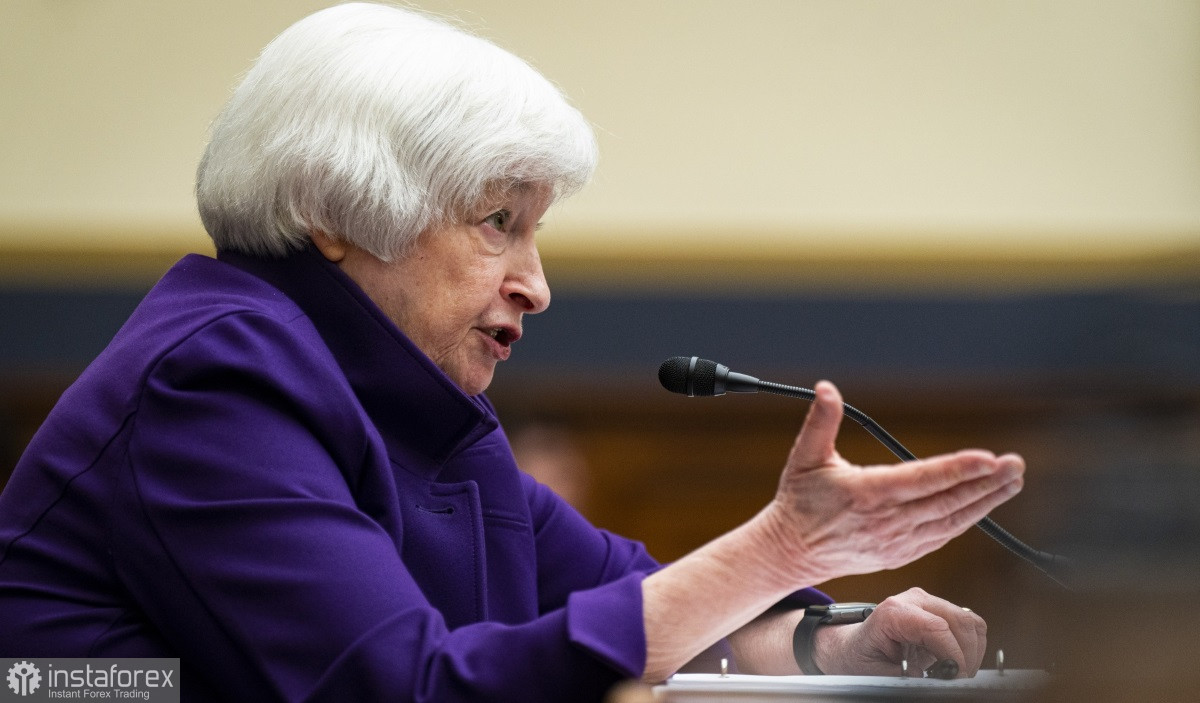
Yellen says the prolonged impact of the US?Iran war on oil markets could produce two interrelated negative effects. First, US economic growth is likely to slow down. That would stem from higher costs for businesses, a possible pullback in consumer demand, and disruptions to global supply chains caused by instability in energy markets.
Second, the conflict carries a risk of increased inflationary pressure. Higher energy prices feed directly into the cost of goods and services and can boost inflation. That creates a difficult choice for the Fed: on the one hand, policymakers would need to tackle rising inflation, possibly by tightening monetary policy; on the other hand, they would need to support a slowing economy and the labor market. This dilemma complicates decision?making and increases uncertainty about the regulator's next moves.
"I think the situation with Iran has further slowed Fed action, making them less inclined to cut interest rates than before," Yellen said.
Inflation is already roughly one percentage point above the Fed's target, Yellen noted. She added that tariffs introduced by President Donald Trump have contributed about half a percentage point to the current 3% inflation rate.
Before the Iran crisis, the Fed had taken the view that labor market weakness had been addressed and that inflation would fall. "But now we have an Iran shock, oil prices have risen substantially — we don't know what will happen in the coming days," Yellen said. "If the closure of the Strait of Hormuz, through which a large share of the region's oil is shipped, lasts more than a few days, prices could remain high or even rise further."
There is a lot of rationality in her remarks: given that the Fed has not yet brought inflation back to 2%, it is reasonable to expect market participants to start fearing renewed price pressure and a tougher Fed stance, which would be another reason to buy the US dollar and would materially slow US economic growth.
Despite the current risks, including the conflict with Iran, the former Fed chair said: "Ultimately, the US economy is in fairly good shape, and I am quite optimistic about the economic outlook."
Yellen also criticized several actions by the Trump administration toward the Federal Reserve, including the president's attempt to remove Governor Lisa Cook and the criminal prosecution of Powell.
Technical outlook on EUR/USD
Buyers now need to reclaim 1.1635. Only that will allow a test of 1.1670. From there, the instrument could climb to 1.1710, but doing that without support from major players will be difficult. The most distant upside target is 1.1745. On the downside, I expect significant buyer interest only around 1.1590. If there is no buying activity there, it would be prudent to wait for a new low at 1.1550 or open long positions from 1.1525.
Technical outlook on GBP/USD
Pound buyers need to take the nearest resistance at 1.3315. Only that would enable buyers to target 1.3360, above which a further breakout will be difficult. The most distant upside target is 1.3410. On the downside, bears will try to seize control of 1.3270. If they succeed, breaking that range would deal a heavy blow to the bulls and push GBP/USD down to 1.3235 with a potential extension to 1.3210.


