
यह भी देखें


 17.03.2026 09:13 AM
The price of gold continues to fluctuate within a narrow range as traders weigh inflationary risks against efforts to contain the oil crisis stemming from the war in the Middle East.
Gold prices rose by 0.5% over the past day and remain above $5,000 per ounce after a 0.3% decline in the previous session. Oil prices increased following a decline for the first time in nearly a week, as Iran intensified attacks on energy infrastructure around the Persian Gulf, even as the US prepares to release the first part of emergency oil reserves.
As the US-Israeli war with Iran enters its third week and rising energy prices amplify inflation concerns, the prospects for interest rate cuts by the Federal Reserve and other central banks have diminished. Traders see little chance of a rate cut in the Fed meeting, the results of which will be known tomorrow. Higher borrowing costs generally exert pressure on precious metals that do not yield interest.
Analysts agree that the Federal Reserve is likely to maintain the current level of the key rate. This consensus is based on a number of factors, including steady, albeit moderate, employment growth and inflation, which, despite some deceleration, is expected to spike significantly by the end of March.
As I noted earlier, the impact of higher borrowing costs on precious metals such as gold and silver is traditionally negative. These assets become less attractive to investors when alternative investments, such as bonds, offer higher yields since they do not generate interest income. Therefore, as long as rates remain high, pressure on precious metal prices will persist, limiting their potential for growth.
However, it is worth noting that other factors also influence the precious metals market. Geopolitical tension, economic uncertainty, and demand from emerging markets can partially mitigate the negative impact of interest rates.
Gold has already appreciated by about 16% this year, as geopolitical uncertainty and threats to the Fed's independence support demand for safe-haven assets. The upward momentum has stalled since the onset of the war on February 28, but concerns about stagflation—a combination of slowing growth and high inflation—continue to support gold in the long term, enhancing the metal's appeal as a store of value.
Demand for gold remains particularly high in China, where investors have been increasing their holdings of gold in exchange-traded funds since returning from the New Year holidays on February 24.
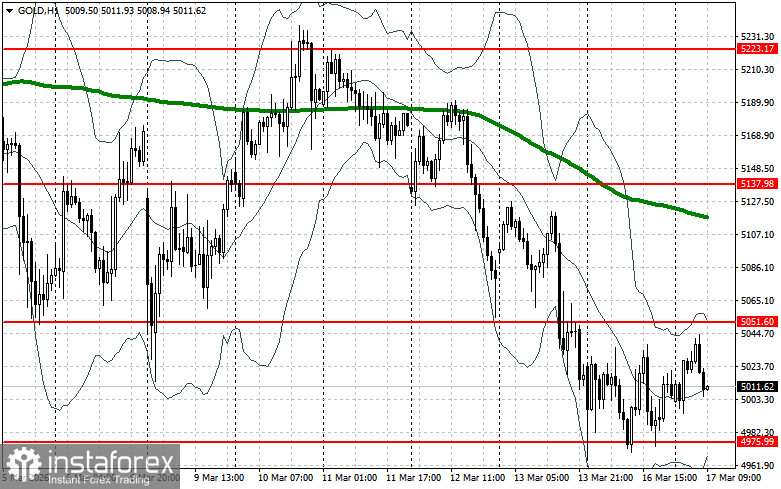
As for the current technical picture of gold, buyers need to reclaim the nearest resistance at $5,051. This will allow them to target $5,137, above which it will be quite challenging to break. The farthest target will be around $5,223. If gold prices decline, bears will attempt to take control of $4,975. If they succeed, breaking this range will deliver a serious blow to the bulls' positions and push gold down to a low of $4,893, with a prospect of reaching $4,835.

