
یہ بھی دیکھیں


 02.10.2026 12:36 PM
Analysis of Trades and Trading Tips for the Euro
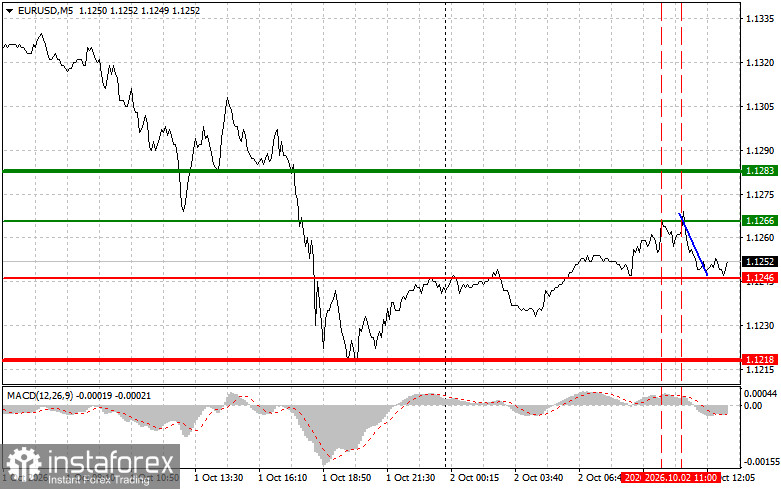
The test of 1.1266 occurred when the MACD indicator had moved significantly above the zero line, limiting the pair's upward potential. The second test of 1.1266 coincided with the MACD being in the overbought zone, which led to the implementation of Scenario No. 2 for selling the euro. As a result, the pair declined by 20 points.
The main uncertainty surrounding September inflation in the euro area is related less to the 3.8% figure itself than to how it will affect the debate within the ECB. The preliminary estimate showed an acceleration from 3.3% in August, while the euro barely rose because traders had already priced in such a result immediately after the regulator's September decision. There was little reason to buy the currency on an expected event, so the market reaction was muted.
The next focus is the September US employment report, which is important for the euro not only as macroeconomic data but also as a way to assess how far apart the trajectories of the two central banks are. Nonfarm employment in the United States is expected to increase by 90,000, and initial market reactions will be based on this figure. The other components are no less important. The unemployment rate shows how tight the labor market remains, average hourly earnings reflect wage pressure on prices, while private-sector employment provides a clearer picture by excluding the influence of government hiring, which has often distorted the overall result in recent months.
For EUR/USD, the situation is asymmetric. The euro already has support from interest-rate expectations, as euro-area inflation accelerated to 3.8% in September, while the ECB has raised its rate and has not ruled out further tightening. Therefore, strong US data would not eliminate the arguments in favor of the euro, but would force the market to reassess the policy gap between the two central banks. A strong report would strengthen the dollar and bring the pair closer to the nearest support levels. Oil would add to the downward risks, as it continues to put pressure on the euro area's terms of trade, while France is also facing its own turbulence. A weak report would give the euro an opportunity to rebound at the end of the week, and the move could be more pronounced than usual because positions have already shifted in favor of the dollar.
As for the intraday strategy, greater emphasis will be placed on the implementation of Scenarios No. 1 and No. 2.
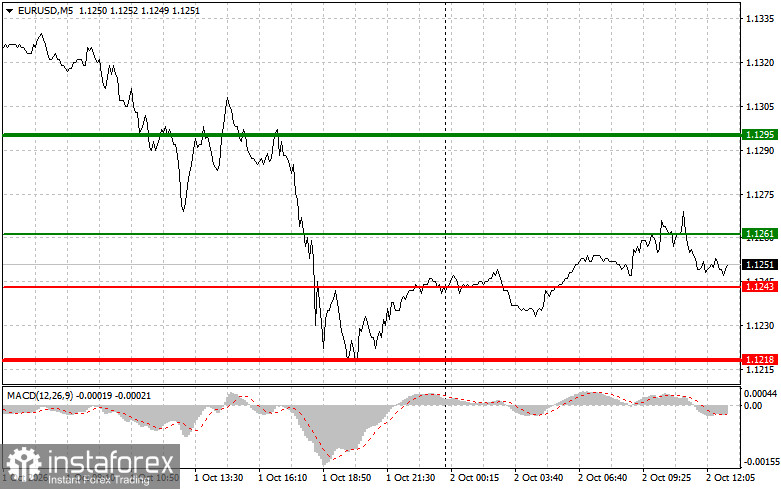
Scenario No. 1: Today, the euro can be bought when the price reaches around 1.1261 (the green line on the chart), with the target of rising toward 1.1295. At 1.1295, the position can be closed, while the euro can also be sold in the opposite direction, targeting a move of 30–35 points from the entry point. A rise in the euro today can be expected following weak US data. Important! Before buying, make sure that the MACD indicator is above the zero line and is only beginning to rise from it.
Scenario No. 2: The euro can also be bought today if the price tests 1.1243 twice consecutively while the MACD indicator is in the oversold zone. This would limit the pair's downward potential and lead to a reversal of the market to the upside. A rise toward the opposite levels of 1.1261 and 1.1295 can be expected.
Scenario No. 1: The euro can be sold after the price reaches 1.1243 (the red line on the chart). The target will be 1.1218, where the position can be closed and the euro bought immediately in the opposite direction, targeting a move of 20–25 points in the opposite direction from the level. Downward pressure on the pair could return at any time. Important! Before selling, make sure that the MACD indicator is below the zero line and is only beginning to decline from it.
Scenario No. 2: The euro can also be sold today if the price tests 1.1261 twice consecutively while the MACD indicator is in the overbought zone. This would limit the pair's upward potential and lead to a reversal of the market to the downside. A decline toward the opposite levels of 1.1243 and 1.1218 can be expected.
Important. Beginner Forex traders should be very cautious when making market-entry decisions. Before the release of important fundamental reports, it is generally preferable to stay out of the market to avoid being caught in sharp exchange-rate fluctuations. If trading during news releases, always use stop orders to minimize losses. Without stop orders, the entire trading account can be lost very quickly, especially when money management is not used and large position sizes are traded.
Remember that successful trading requires a clear trading plan, such as the one presented above. Making spontaneous trading decisions based on the current market situation is inherently a losing strategy for an intraday trader.


