
یہ بھی دیکھیں


 02.10.2026 05:56 PM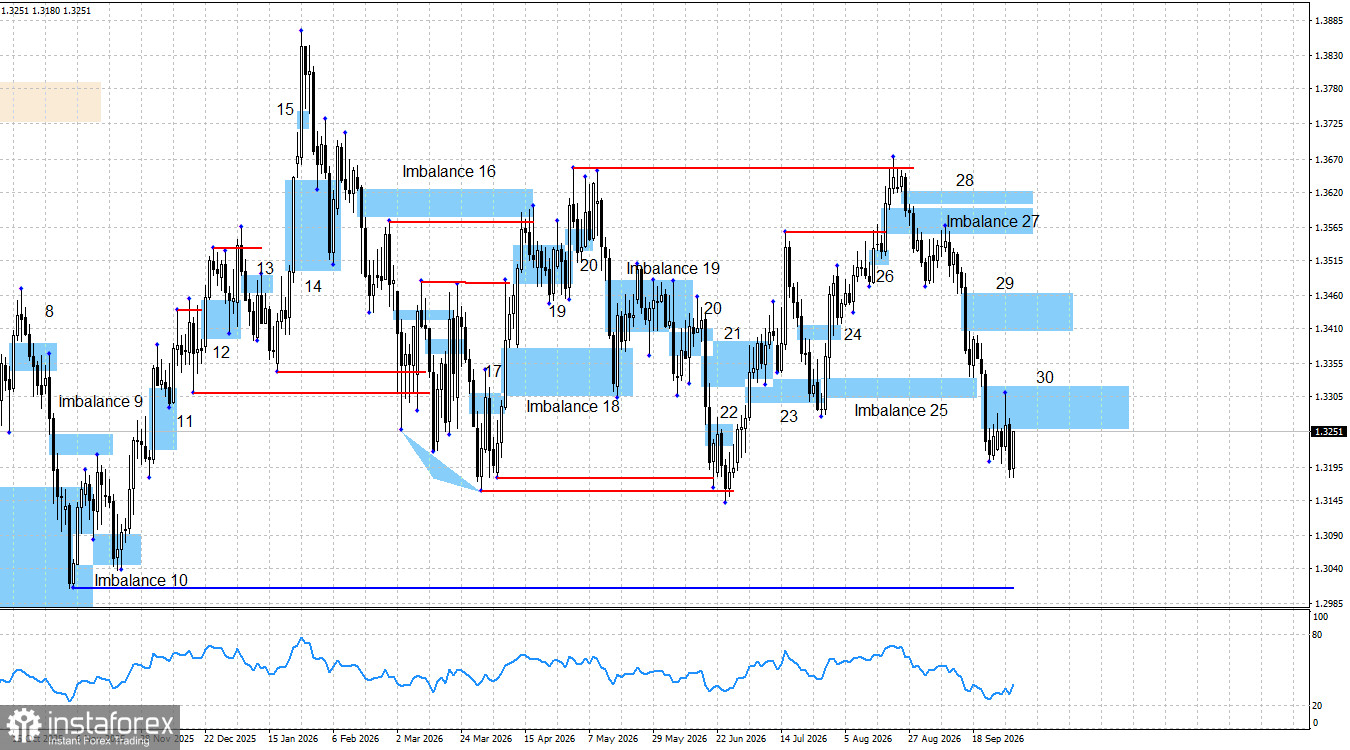
GBP/USD declined for eleven consecutive days, but this week the pair has made several attempts to begin a corrective pullback. In the first half of the week, the pound failed to attract traders' attention, and there was little news during those days. However, on Wednesday, several important events supported the pound, and several important reports provided further support on Friday. It all began with a speech by John Williams, who made traders less confident that the Federal Reserve would raise interest rates for a second consecutive time in October. The UK GDP report for the second quarter then showed year-on-year growth of 1.4%, compared with the market expectation of 1.2%. Next, an important US inflation report came in below market expectations, partly confirming John Williams' remarks. In just one day, the market almost completely abandoned its expectations of another round of Fed tightening in October, yet this did not help the pound. On Friday, the US Nonfarm Payrolls report and unemployment rate showed disappointing figures, but this only allowed the pound to recover to its average levels for the current week. Thus, despite highly favorable economic news, the pound was effectively unable to post any meaningful growth.
It should also be noted that traders expect the Bank of England to deliver the same two monetary policy tightenings as the Federal Reserve. Moreover, as noted above, the dot plot points to just one policy tightening. Thus, the Bank of England could ultimately tighten monetary policy even more than the Federal Reserve, which clearly should not support further gains in the US dollar. Yet the dollar is rising in most cases.
Despite the unfavorable picture for the British pound that has developed in recent weeks, the dollar has also faced numerous negative factors in recent months. Had the Federal Reserve not decided to raise interest rates in September and indicated its readiness to tighten policy at least once more before the end of the year, the US dollar would still be expected to decline. That remains the expectation, but from lower levels. However, the bulls' chances now depend only on a liquidity sweep of the low from July 28 or June 24, as well as the formation of new bullish patterns, which would require a sustained upward move. The chart clearly shows that most reversals over the past year occurred after liquidity sweeps, so this represents a potential opportunity. Yesterday, the price reacted to bearish imbalance 30, but the reaction was rather weak, which could indicate that the bearish momentum is fading. This could provide an opportunity for the pound. A limited one, but still an opportunity.
Do the bears have further potential? There appears to be little, but it should be acknowledged that the dollar remains in a favorable phase and retains strong potential for further gains until imbalance 30 is invalidated. The Federal Reserve not only decided to raise interest rates but also signaled to traders this week that it is prepared to continue tightening. A prolonged decline in GBP/USD is unlikely to be driven by this factor alone, but in recent weeks the market has done little other than price in the FOMC rate hike. What could prevent it from buying the dollar for several more weeks amid Fed monetary tightening?
Chart analysis shows that the picture became fully bearish after the liquidity sweep of the May highs. The pound reacted to bearish imbalance 27, triggering a 320-point decline. Imbalance 25 was the target of the decline, and this pattern was both reached and broken through. Bearish imbalance 30 represents a strong resistance zone for the bulls.
The economic news flow on Friday supported the pound, as the two most important US labor-market reports of the week, covering employment and unemployment, showed very weak figures. However, although the bulls launched a counterattack, they failed to change the market situation. The outlook for the pound remains highly uncertain.
The overall news backdrop remains such that, over the long term, a decline in the US dollar remains the only expected scenario. The war between Iran and the United States has not changed this outlook. Geopolitical developments prompted the market to return to the dollar's safe-haven status for several months, but the conflict has already passed its most acute phase. The future of FOMC monetary policy remains uncertain, while the market continues to anticipate only further tightening, which is the main reason for the bears' positive sentiment. Any gains in the dollar appear to be temporary and driven by short-term factors. It should also be noted that GBP/USD has been trading within a range for an entire year. A range allows for virtually any price movement within its boundaries.
US and UK Economic Calendar:
On October 5, the economic calendar contains one event that can be considered important. The economic backdrop will affect market sentiment during the second half of Monday's trading session.
GBP/USD Forecast and Trading Recommendations:
The long-term outlook for the pound remains bullish. The bears have controlled the initiative in recent weeks, but the range is clearly visible even on the daily chart. The liquidity sweep of the swing low from May 1 triggered a new decline, while the sell signal within inverted imbalance 27 allowed the decline to continue. Thus, the pound remains in a near free fall that could continue toward the June lows, where a liquidity sweep could occur, followed by a reversal in favor of the pound. However, in the near term, the price could react once again to bearish imbalance 30, potentially generating a sell signal.


