
আরও দেখুন


 02.10.2026 11:08 AM
The wave structure on the 4-hour chart for EUR/USD is becoming more complex. There is still no question of invalidating the upward section of the trend (lower chart), which began in January last year. On the contrary, a complete A-B-C corrective structure has emerged, which may be complete. However, recent events related to the Federal Reserve and its policy have once again affected the current wave structure, making it more complex. It should be noted that the news background and wave structure often conflict with each other, making adjustments necessary.
The wave structure has now transformed into a more complex formation. Wave C has taken a three-wave form, while the next wave is identified as wave D. The entire trend section that began on January 27 may take the form of a five-wave corrective structure, A-B-C-D-E. If this assumption is correct, wave D is complete, and on August 21, EUR/USD entered the phase of forming wave E, whose low should be below the low of wave C at 1.1325. The instrument is now only a short distance from this level, and below it, the presumed wave E could complete its formation at any time.
The Most Challenging Period for the Euro Is Ahead
EUR/USD declined by another 90 basis points on Thursday. Attempts to explain the continued strengthening of the US currency, which has occurred almost every day, are unlikely to produce a definitive answer. There are always possible explanations, but it is impossible to be certain that these particular factors are driving the market's demand for the dollar. At present, economists' views are not particularly diverse. Almost all point to rising geopolitical tensions (although this is not entirely the case when referring to the Middle East), as well as stronger "hawkish" rhetoric from Fed officials in September (which the market has already been pricing in for almost a month). These factors could certainly have supported demand for the US currency. However, it is unlikely that anyone could have expected such a sharp decline in EUR/USD after the Fed meeting, given that the pair had also been declining before the meeting.
Today, the market will focus on the US labor market and unemployment reports, as well as inflation data from the European Union. The current significance of the Consumer Price Index in the euro area appears limited, as the market did not react even to two rounds of ECB monetary policy tightening. If the market is not responding to ECB interest rates, then what significance does inflation have for it? The US labor market is a different matter, as approximately 50% of the latest strengthening of the dollar is related specifically to the Fed's "hawkish" outlook. Therefore, a weak Nonfarm Payrolls reading or a high unemployment rate could finally cool sellers' momentum. However, it should be noted that in recent weeks the market has been buying the US currency not because of a high probability of tightening in October or over a longer-term horizon. The probability of monetary policy tightening in October actually declined following John Williams' remarks and the weak PCE indices.
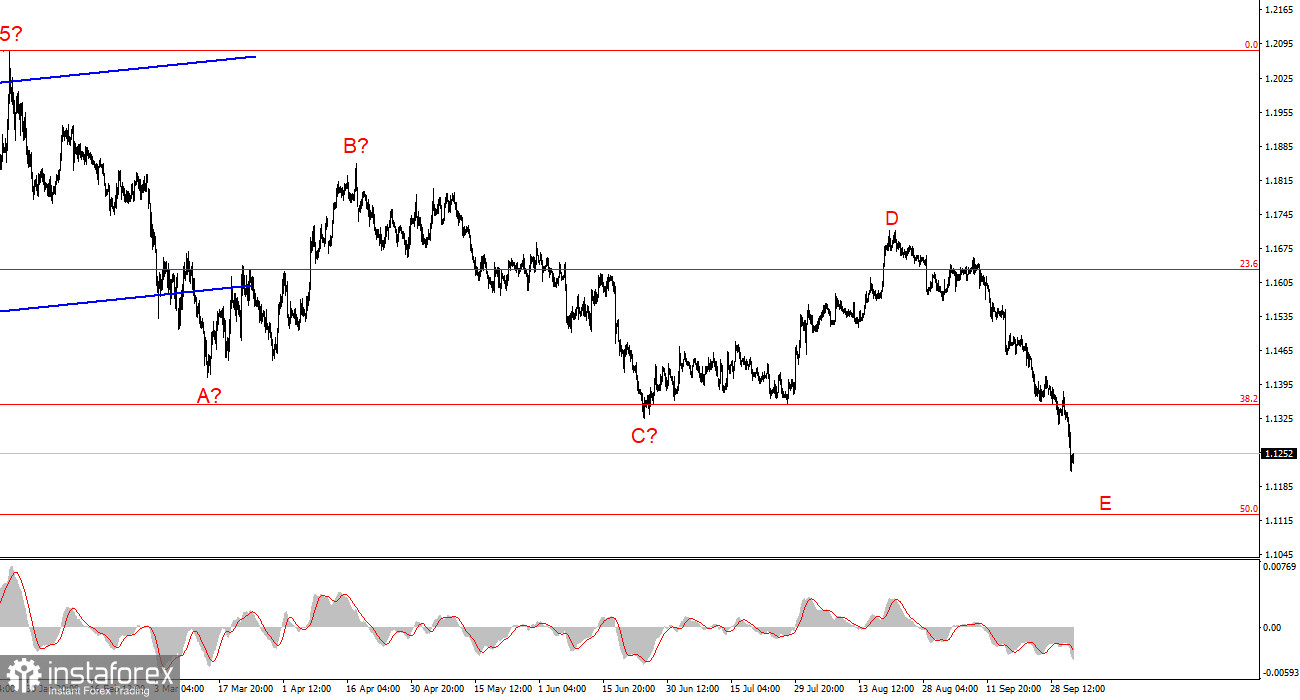
Based on the EUR/USD analysis, the pair remains within the global A-B-C-D-E corrective section of the trend. If this assumption is correct, the decline in quotes will continue toward targets below the low of wave C at 1.1325. This scenario was considered an alternative, and if not for the Fed meeting, it would have remained a reserve scenario. However, the Fed delivered a surprise, leaving the market with no other options but a new wave of US currency buying. However, buying has continued for several weeks, despite the absence of new factors supporting the dollar. Opening short positions in such a news environment would not be advisable; instead, preparations should be made for a reversal.
On the higher time frame, a downward section of the trend can be seen taking the form of A-B-C-D-E. Consequently, EUR/USD may continue declining below the low of wave C, while the internal wave structure of wave E may take the form of a five-wave impulse.
Main Principles of the Analysis:


