
Lihat juga


 26.06.2026 08:09 AM
As the data showed, the American economy in the first quarter was noticeably stronger than previously thought. According to the third and final estimate, U.S. real GDP grew by 2.1 percent on an annualized basis, compared with 0.5 percent in the fourth quarter of 2025. This is a revision up by 0.5 percentage points from the second estimate of 1.6 percent, a pleasant surprise, as the market was anticipating confirmation of weakness rather than an acceleration.

However, the mechanics of this revision are curious. The primary contribution to the improvement came from a reduction in the import estimate, which is subtracted when calculating GDP, only partially offset by a downward revision of consumer spending. In other words, the headline figure increased in part due to technical reasons rather than solely from a real strengthening of domestic demand. This is also confirmed by a more indicative metric. Real sales to domestic buyers, which sum up consumption and private investment and are considered a better measure of core demand, increased only by 1.7 percent and were revised down by 0.7 percentage points. Thus, in real terms, the economy is worse than suggested by the overall figure of 2.1 percent.
From an industry perspective, the picture was buoyed by the government sector, which added a solid 7.5 percent, and private goods manufacturing, which grew by 4.5 percent, while the services sector only added a modest 0.8 percent. Leading industries included information technology, the federal government, professional and scientific services, and durable goods manufacturing. Here, the influence of the investment boom around artificial intelligence is clearly visible. Major underperformers included retail and wholesale trade, as well as finance and insurance, which aligns with the weakness of the consumer sector that we saw in retail data.
The inflation component of the report warrants special attention and is concerning. The PCE price index within GDP for the first quarter was 4.6 percent, while the core measure reached 4.4 percent. This is higher than the monthly PCE values in May and serves as a reminder that price pressure remained high even before the peak of the military spike in oil prices. Corporate profits, meanwhile, grew by $74.4 billion and were revised upward, explaining the resilience of the stock market and its willingness to ignore geopolitical shocks.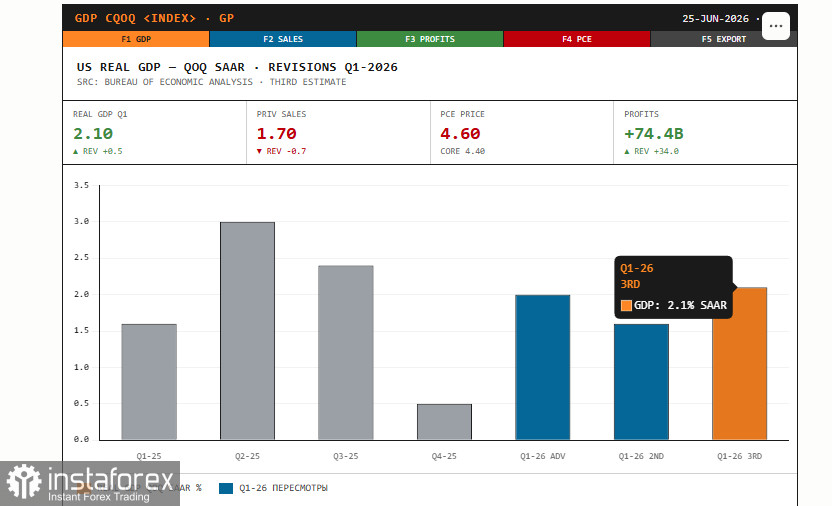
For the Federal Reserve, this report presents an ambiguous picture but leans more toward reinforcing the hawkish line. On one hand, the economy is growing at 2.1 percent and clearly does not need stimulus, and corporate profits are setting records. On the other hand, inflation in the GDP data confirms what Goolsbee mentioned yesterday and what the May PCE showed. Price pressure is persistent and remains significantly above the target. Let me remind you that Kevin Warsh made it clear at the first meeting that he was ready to raise rates, and that strong GDP growth combined with high inflation supports his argument.
The main mitigating factor remains the collapse of oil prices following the Iranian agreement, which should cool inflation in the coming months. However, as long as real economic data comes out as strong as it has, the market is likely to price in a rate hike this year rather than a cut. For the dollar, this points to further growth against the euro, British pound, and other risk assets.


