
Lihat juga


 16.09.2026 08:53 AM
Of the total Bitcoin issuance of 21 million coins, retail holders own 13.9 million BTC, or 66.6% of the total supply, making private investors the largest category of asset owners. Institutional entities, companies, funds, exchange ETFs, and state reserves control significantly less — 3.5 million BTC, or 16.7% — but this category has grown faster than others over the past two years amid the launch of spot ETFs and corporate accumulation programs like Strategy. Another 1.62 million BTC, about 7.7% of issuance, analysts attribute to permanently lost coins left on lost wallets or inaccessible private keys from the network's early years.

Separately noteworthy is Satoshi Nakamoto's reserve, estimated at 968k BTC, or 4.6% of issuance; these coins have not moved since the network's creation and are highly likely to remain inactive. The remaining 919k BTC, 4.4% of the maximum supply, are yet to be mined under the current miner-reward protocol.
The cause-and-effect link here matters not for its own sake but for how this structure determines price behavior. Retail formally owns the majority of coins, but historically retail tends to panic-sell on drawdowns and buy late at peaks, whereas institutions, despite a smaller share, increasingly set directional flow via ETF inflows and corporate purchases — as illustrated by the recent capital rotation between bitcoin and ether funds.
The beneficiary of the growing institutional share is the market overall, because such holders sell less on volatility and create more stable structural demand. In contrast, for retail investors, a rising concentration of institutional holdings means a declining ability to influence price proportionally to their ownership share.
It is also notable that more than 12% of the maximum issuance — lost coins plus Satoshi's reserve — are effectively removed from circulation forever and will never come to market. That makes the supply actually available for trading materially smaller than the nominal 21 million figure, which structurally supports price over the long horizon regardless of short-term demand swings.
As for short-term trading, the strategy and conditions are described below.
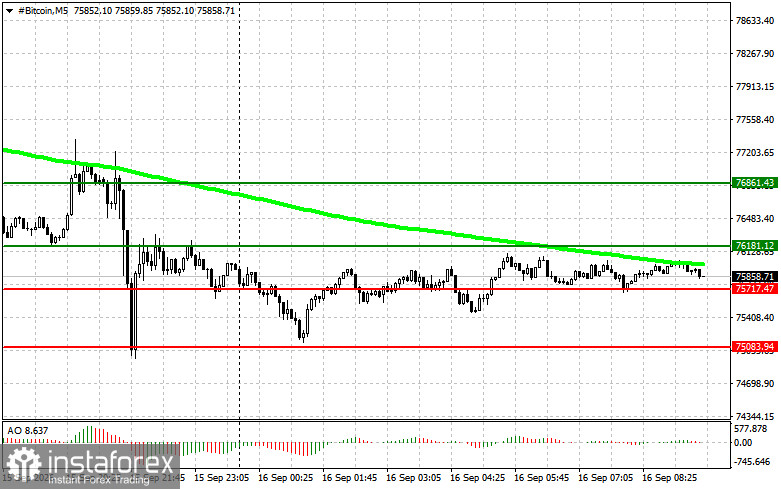
For Bitcoin, the price is holding in the $75,000–76,800 range, and the trading plan is built around two mirrored directions with a full set of breakout and rejection scenarios. A breakout above $76,200 opens a buy position toward $76,800, where you should take profit and consider a reversal into a short on a possible pullback. Entry conditions are mandatory: price must remain above the 50-day moving average, and the Awesome Oscillator must be in positive territory. The second buy variant works on a rejection: if price approaches the lower boundary at $75,700 but a downside breakout is not confirmed, treat it as a false spike and open a long position targeting $76,200 first, then $76,800 as a wider technical reference if the move extends beyond the near range.
Sell positions are arranged in the opposite direction. A confirmed break below $75,700 leads to a short position targeting $75,000, with mirror conditions — the moving average above price and Awesome below zero. The second sell variant works on a rejection at $76,200; if an upside breakout is not confirmed, this opens the path for a short sequentially to $75,700 and then $75,000.
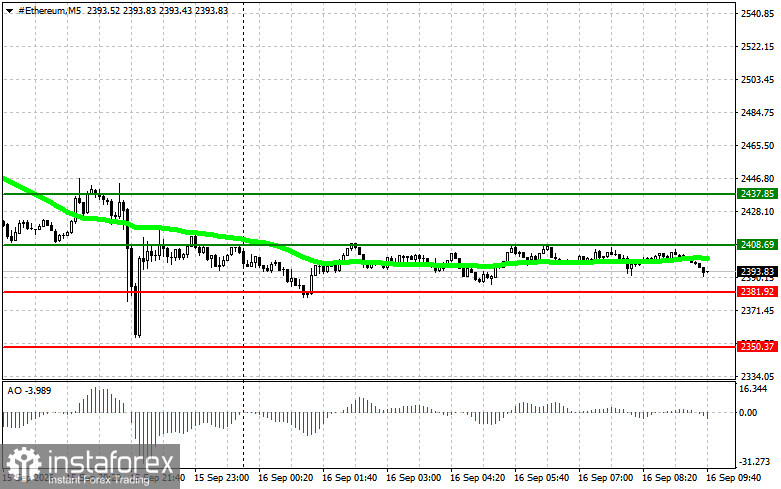
For Ether, the price trades in the $2,350–2,437 range, and the logic fully mirrors Bitcoin on its own price scale. A breakout above $2,408 signals a buy toward $2,437 under the same conditions: a rising moving average below price and Awesome above zero. The second buy variant works on a rejection at $2,381; if a downside breakout is not confirmed, target a return first to $2,408 and then to $2,437 as a wider reference for continued movement.
Ether sells begin from a break below $2,381, targeting $2,350, with price below the moving average and Awesome in negative territory. The second sell variant works on a rejection at $2,408; if an upside breakout is not confirmed, the aim is to return to $2,381 and then to $2,350. Both indicators serve only as filters to exclude false moves, not as independent reasons to enter early, so decisions are made only after price actually confirms the specified levels.


