There are a few macroeconomic reports scheduled for Thursday. All market attention will be on the European Central Bank and Bank of England meetings. Among the macroeconomic reports, one can highlight retail sales in the European Union. All other statistical data is rather secondary in nature.
Analysis of Fundamental Events:
On Thursday, the ECB and the BoE meetings stand out as key fundamental events, but it is important to understand what to expect from them. The only thing traders are interested in regarding the ECB meeting is any potential hints from Christine Lagarde about future rate cuts. Recall that this week the EU inflation report showed a slowdown to 1.7%, which may force the central bank to reconsider easing monetary policy. Clearly, this is not the best scenario for the euro currency.
The situation with the BoE is somewhat different. The British central bank has not completed its easing cycle; it is doing so gradually, depending on inflation data. The latest UK inflation report showed an acceleration, so a new cut in the key rate is unlikely in February and March. However, the market will certainly pay attention to the voting results of the Monetary Policy Committee regarding the rate. It is expected that only 2 votes will be cast in favor of a cut. If there are actually more votes for a cut, the British pound could come under pressure, though likely not strongly or for a prolonged period.
General Conclusions:
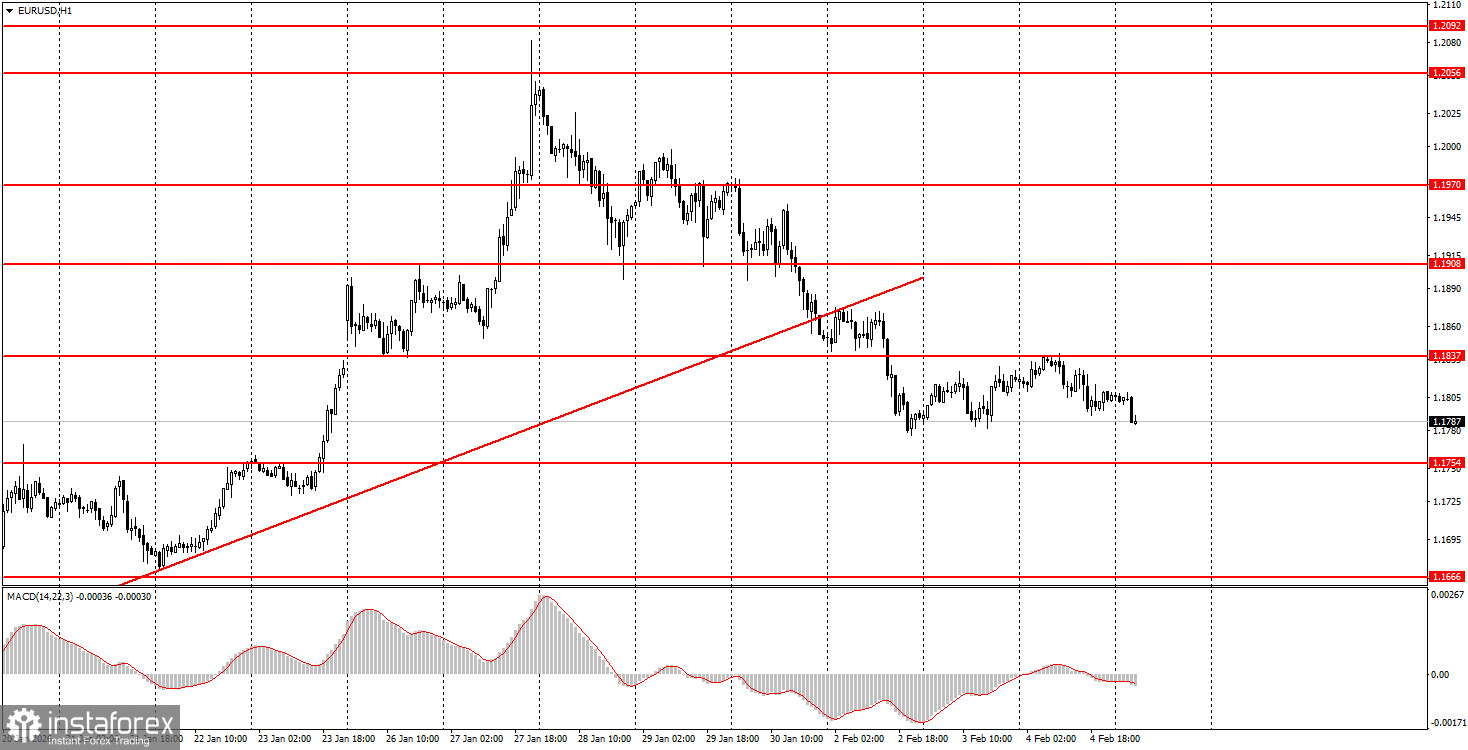
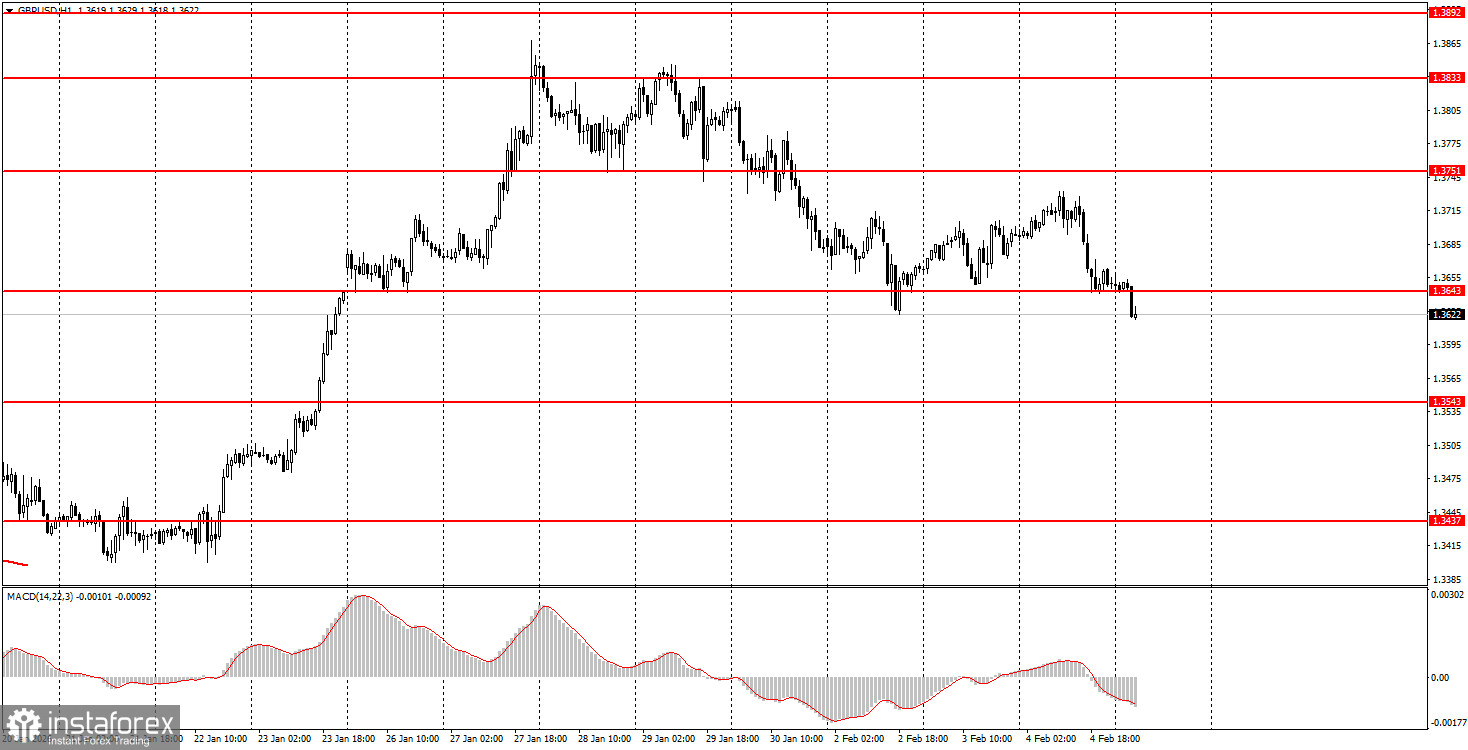
On the penultimate trading day of the week, both currency pairs may be quite volatile, as important events are scheduled for today. The euro can be traded today from the areas of 1.1830-1.1837 and 1.1745-1.1754, while the British pound can be traded from the area of 1.3643-1.3652. Fundamental events could send the dollar into another knockout at any moment.
Main Rules of the Trading System:
The strength of the signal is determined by the time it took to form the signal (rebound or breaking through the level). The shorter the time, the stronger the signal.
If two or more trades were opened around a particular level based on false signals, all subsequent signals from that level should be ignored.
In a flat market, any pair can generate numerous false signals or no signals at all. In any case, it is best to stop trading at the first signs of a flat.
Trades are opened during the time period between the start of the European session and until the middle of the American session, after which all trades should be manually closed.
On the hourly timeframe, signals from the MACD indicator should ideally be traded only when there is good volatility and a trend confirmed by a trend line or channel.
If two levels are too close to each other (ranging from 5 to 20 pips), they should be considered as a support or resistance area.
After moving 15-20 pips in the correct direction, it is advisable to set the Stop Loss to break-even.
What's on the Charts:
Support and resistance levels are targets for opening buy or sell trades. Take Profit levels can be placed around them.
Red lines indicate channels or trend lines that reflect the current trend and indicate the preferred direction for trading now.
The MACD indicator (14,22,3) – the histogram and signal line – serves as a supplementary indicator that can also be used as a source of signals.
Important speeches and reports (always found in the news calendar) can significantly influence the movement of the currency pair. Therefore, during their release, trading should be conducted with maximum caution, or it is advised to exit the market to avoid a sharp price reversal against the preceding movement.
Beginners trading in the Forex market should remember that not every trade can be profitable. Developing a clear strategy and practicing sound money management are the keys to long-term trading success.
You have already liked this post today
*A análise de mercado aqui postada destina-se a aumentar o seu conhecimento, mas não dar instruções para fazer uma negociação.



 05.02.2026 06:59 AM