
Vea también


 05.08.2026 09:24 AM
Gold jumped to a four-week high, rising momentarily by 2.5% to $4,179.53 per ounce after the prospect of a temporary agreement to resume operations in the Strait of Hormuz alleviated inflation concerns and the likelihood of a Federal Reserve rate hike. Silver also saw a sharp increase.
The rally was triggered by statements from several parties involved in the negotiations. President Trump stated to reporters in Los Angeles on Tuesday that talks with Iran are "progressing very well," and Axios reported that Washington, Tehran, and Oman are close to an agreement, with the U.S. looking to announce it later on Wednesday. Qatar stated that a draft proposal has already been prepared, and U.S. Treasury Secretary Scott Bessent said that a deal to open the Strait of Hormuz could be finalized on Tuesday or Wednesday.
The mechanics of how this news affects gold are direct and well known: markets are now fully pricing in only one Fed rate hike by the end of the year, down from two just a week ago. A less hawkish monetary policy is generally positive for non-yielding precious metals, which explains the sharp price movement.
The scale of gold's decline since the start of the conflict remains a significant reminder of the depth of the correction it has undergone. Since the outbreak of the U.S.-Iran war in late February, the metal has decreased by more than one-fifth, as the conflict has fueled energy prices, heightened inflationary pressure, and increased the likelihood that rates will remain high for longer. Nevertheless, at the end of last month, Fed representatives decided to keep policy unchanged for the fifth consecutive time, although three dissenters once again expressed support for a hike.
The position of the Fed itself remains far from unanimous. Philadelphia Fed President Anna Paulson, who voted with the majority, stated on Tuesday that she keeps an "open mind" regarding the future direction of policy, as the signals on whether current policy is sufficiently restrictive remain conflicting. Separately, Kansas City Fed President Jeff Schmidt, in a prepared speech at an event in Omaha, stated that higher rates are necessary to achieve the Fed's price stability goal.
An additional, structurally important factor supporting gold in recent weeks has been Chinese institutional investors, who helped halt the decline triggered by the war and keep prices above the key threshold of $4,000 per ounce.
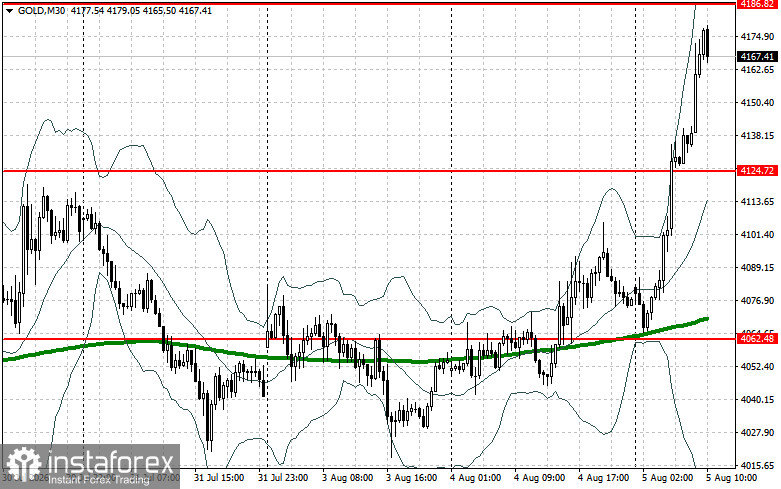
As for the current technical picture of gold, buyers need to overcome the nearest resistance at $4,186. This would allow targeting $4,249, above which it will be quite challenging to break through. The furthest target will be in the $4,304 range. In the event of a decline, bears will attempt to take control at $4,124. If successful, a breakout of this range could deal a serious blow to bull positions and push gold down to a low of $4,062, with the potential to reach $4,008.


