
Vea también


 19.10.2026 11:45 AM
At the end of last Friday, Europe's single currency strengthened against the dollar in the morning, and the pound showed a similar move. The rise came without support from European data; the main focal point was Fed chair Kevin Warsh's speech, which traders hoped for at least some clue on rates.
No clue came. Warsh said he would not give targets or guidance on interest rates and that decisions will be made meeting by meeting. Recall that his stance is the same as before: "I do not pre-decide meetings." He said price pressure worries him, but he does not yet see anything critical, and he described the US economy and labor market as resilient.
The lack of guidance forced market participants to reassess rate bets, even though this week's data show strong price pressure in the US. Remember September CPI, which accelerated to 3.7% year-on-year. As a result, an October hike is now likely postponed, and attention has shifted to December, which markets have partly priced in. That is why Warsh's remarks did not bolster the dollar.
Support arrived later. In the afternoon, US industrial production for September jumped 0.7% versus a 0.4% forecast. That mattered because the prior dynamics had been slowing—0.3% in June, 0.2% in July, and just 0.1% in August—so September's sharp uptick stood out, and the dollar recouped some losses.
Today's Asian trading brought a new twist. The euro opened down with a 30-pip gap and slid as much as 60 pips before the market retraced most of the move. The reaction is directly linked to Europe, and more specifically to France.
There, dissatisfaction with high living costs is intensifying; students are protesting against the education system, and the unrest has reached riots. The French authorities have limited options to resolve the problem, especially by increasing public spending, which the opposition opposes. It was previously noted that German finance minister Lars Klingbeil called France's consolidation plans an important signal for markets, and Bundesbank chief Joachim Nagel did not see a new financial crisis in Europe. Nevertheless, France's fairly serious domestic economic and geopolitical problems continue to weigh on the euro, and they caused the currency's drop. The pound fell with the euro, but its slide was actively bought, while the euro still struggles to rally.
Now to the economic calendar. Today it is almost empty: there is no eurozone data at all, and in the US the only second-tier release this afternoon is a housing market index that rarely drives FX pairs. When statistics are scarce, the market looks elsewhere for guidance, and traders will likely pay more attention to oil prices, statements by Trump, and the situation in France. If such unrest spreads across Europe, it could create more serious structural problems for the euro. Then it would continue to fall versus the dollar and drag down other risk assets.
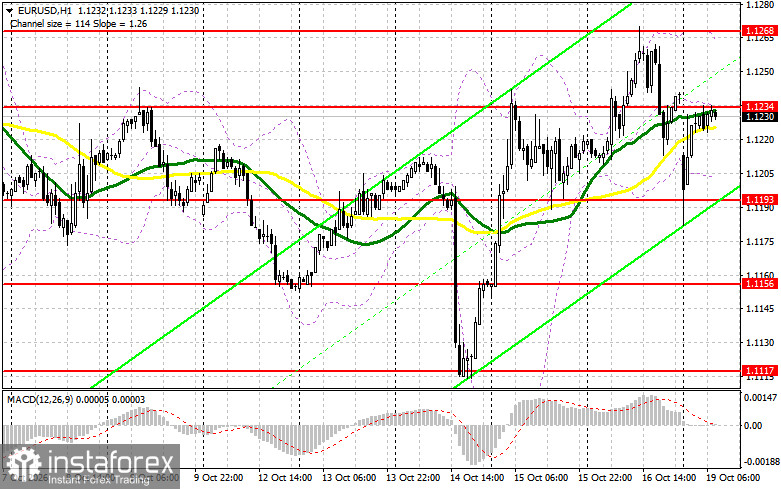
EUR/USD. For shorts the interesting level is 1.1234, where a false break has formed for the third time, and I expect the decline to at least 1.1193. Here I expect stronger buyer interest, as on October 15 and during today's Asian session, so I open longs on a false break at 1.1193, aiming for a return to 1.1234. If there are no buyers at 1.1234, a break and close above that band will push the euro to 1.1268, a new major resistance. I would consider shorts from there only on a failed hold or sell rallies from 1.1310 for 25–30 pips. If there is no activity at 1.1193, I will look at longs only after a false break of 1.1156 or on a bounce from 1.1117 for 25–30 pips.
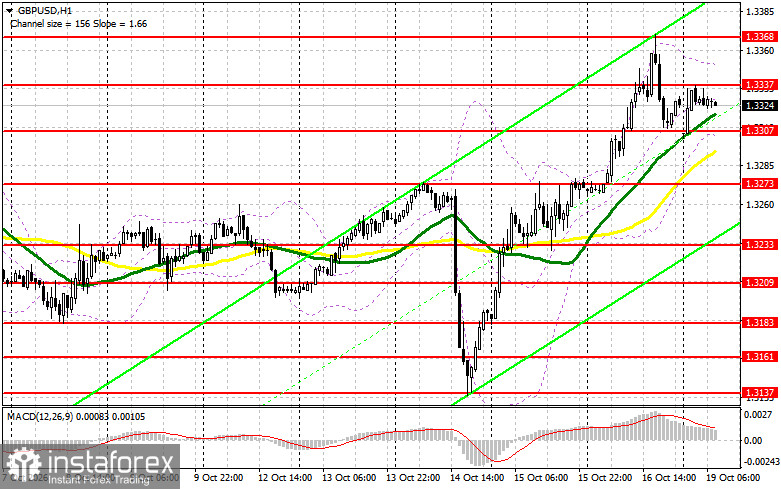
GBP/USD. Upside chances remain. Prefer longs on a correction from 1.3307 on a false break, or on a false break of 1.3283, and buy bounces from 1.3233 for 25–30 pips. Shorts suit 1.3337 on a failed hold, or the monthly high near 1.3368 on a false break, or sell a rebound from 1.3397 for 25–30 pips.
Personally, I would not rush to call the euro this week's leader: while Paris remains unsettled, it will struggle to rise, and any bounce will be sold. The pound has it easier—it has no domestic political shock, and dips are bought more readily. Until new data arrive, the streets of France, oil, and Mr. Trump's remarks will remain key for both pairs.


