
আরও দেখুন


 15.09.2026 04:45 AM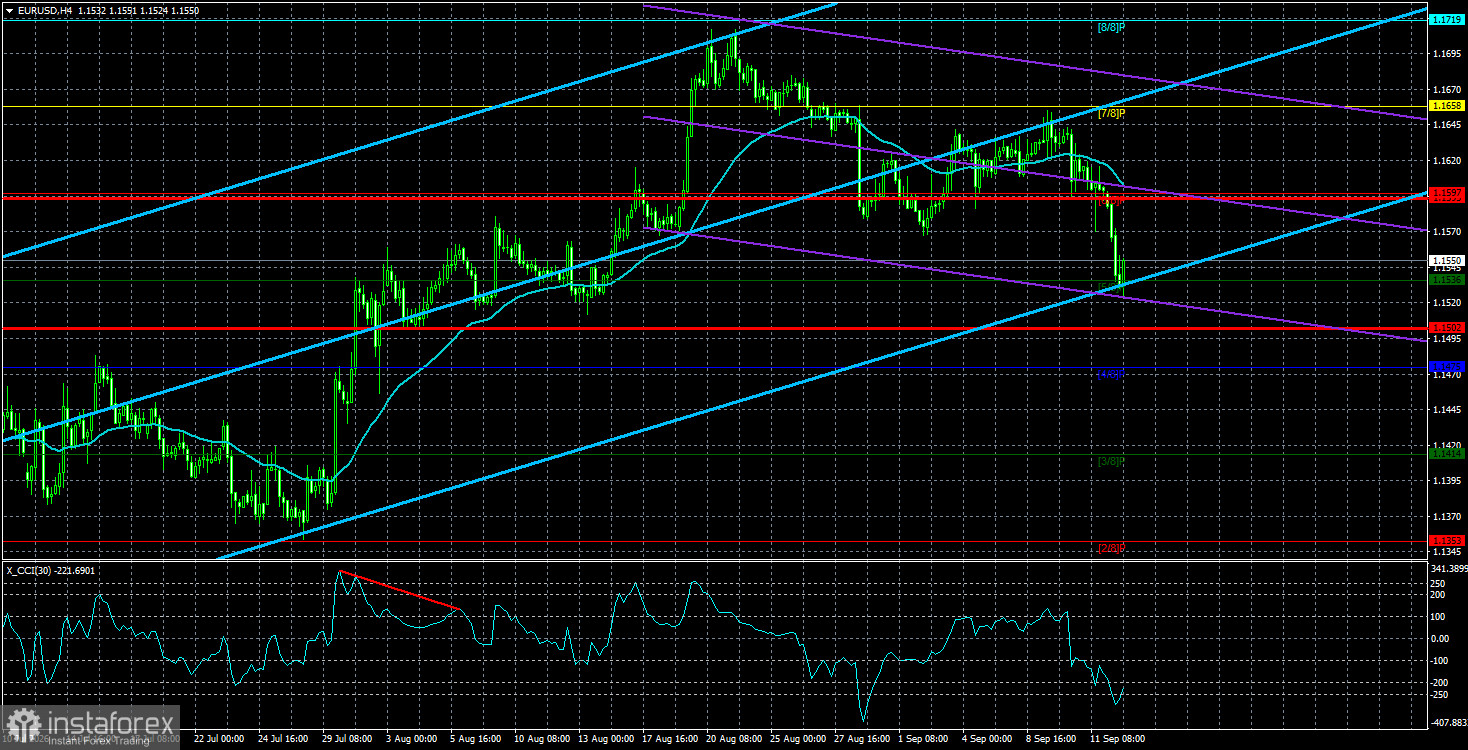
The EUR/USD currency pair unexpectedly plunged about 60 pips on Monday before the start of the U.S. session — a significant move in the current circumstances for a pair that has been moving in a "favor-doing" mode for at least one and a half months. What could have caused the euro's fall, or more precisely — the dollar's rise? In fact, the answer is at once obvious and not obvious. On Wednesday evening the Federal Reserve will hold a meeting at which (as the market has firmly believed for three months) the key rate will be raised by 25 basis points. Most traders think the Fed will pursue tighter monetary policy, which explains the dollar's rise. But is the issue really that simple and unambiguous?
To understand, one must first look at the European Central Bank. The ECB has already raised key rates twice this year and is generally prepared to continue tightening policy in response to inflation having more than doubled since the start of the year. Thus, while the Fed is preparing to tighten, the ECB has already done so twice. However, last Thursday the market effectively ignored the ECB's decision, once again showing that it cares only about Fed policy. Is that fair? Both yes and no.
The market paying more attention to the Fed is no news. The U.S. dollar remains the world's number-one currency, and the U.S. economy is the largest in the world. So it's not surprising that Fed policy matters more to the market than ECB policy. However, in recent months the market has essentially ignored all the ECB's hawkish steps. Put simply, either the dollar falls when it seemingly cannot fall any further, or the dollar rises even though there appear to be no strong reasons for it.
On Wednesday evening the Fed may raise the key rate — and it may just as well leave it unchanged. One can list a long set of "for" and "against" factors. For example: if inflation did not rise in August, why rush to tighten policy when Donald Trump opposes it and appointed Kevin Warsh as Fed chair? Or why raise the key rate in September if the Fed had more grounds to tighten in June or July but didn't? And what about the U.S. labor market and economy, which are slowing further even though Trump wants to see the opposite?
Of course Warsh is formally independent from the White House and is not obliged to listen to Trump. But do traders really believe the President would make the same mistake twice? Eight years ago, he appointed Jerome Powell as Fed chair, hoping to influence the Fed, but that didn't happen: Powell didn't heed the White House and pursued independent policy. Does anyone now think Trump has not taken precautions in case Warsh might seek independence from the White House?
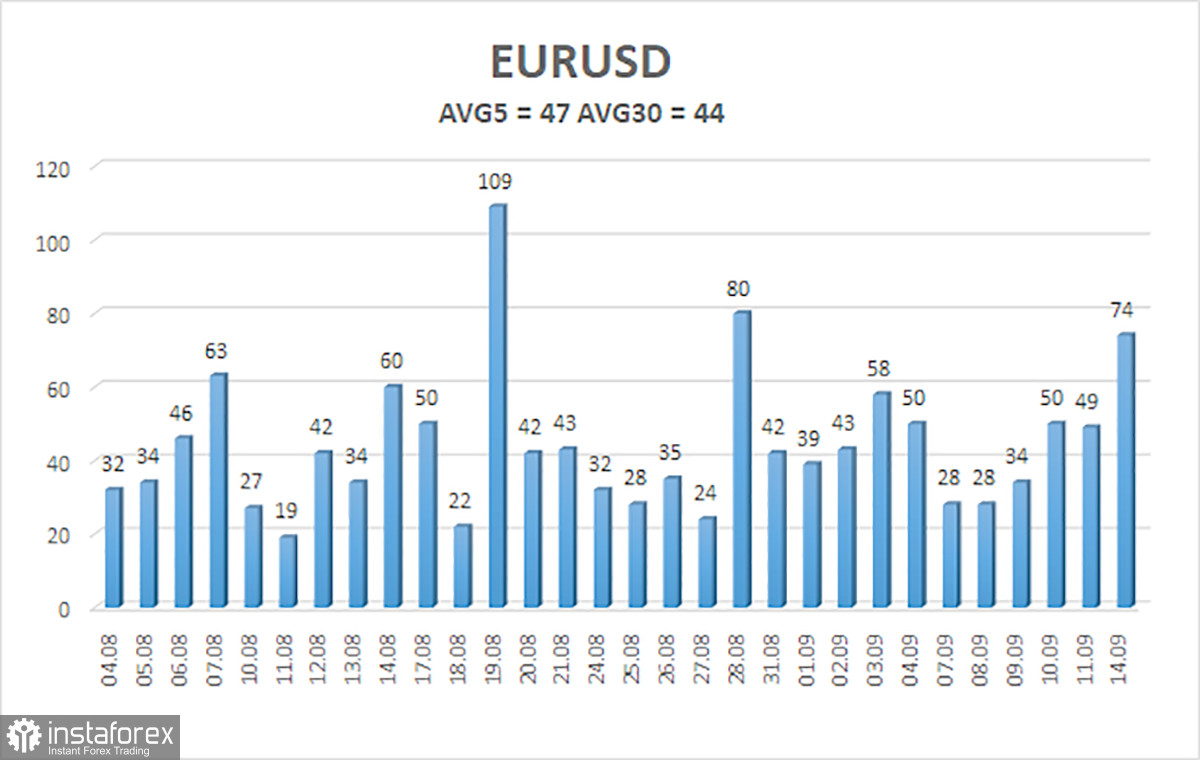
The average volatility of the EUR/USD currency pair over the last 5 trading days as of September 15 is 47 pips and is classified as "low." We expect the pair to trade between 1.1502 and 1.1593 on Tuesday. The higher linear regression channel points up, indicating an uptrend. The CCI has entered the oversold area for the second time, warning of a possible end to the downward correction. A bullish divergence has also formed.
S1 – 1.1536
S2 – 1.1475
S3 – 1.1414
R1 – 1.1597
R2 – 1.1658
R3 – 1.1719
The EUR/USD pair continues an uptrend on the 4-hour timeframe, which may be the start of a new leg of a global uptrend on higher timeframes. The global fundamental backdrop for the dollar remains negative, but in 2026, geopolitics first and then the Fed's hawkish stance provided strong support for the US currency. However, at present, those factors no longer support the dollar. With the price below the moving average, consider shorts on a corrective basis, targeting 1.1502 and 1.1475. Above the moving average line, long positions remain relevant, with targets at 1.1658 and 1.1719.
Regression channels help determine the current trend. If both are directed in the same direction, it means the trend is currently strong;
The moving average line (settings 20,0, smoothed) defines the short-term trend and the direction in which trading should be conducted at present;
Murray levels are target levels for moves and corrections;
Volatility levels (red lines) are the probable price channel within which the pair will spend the next 24 hours based on current volatility indicators;
The CCI indicator – its entry into the oversold area (below -250) or the overbought area (above +250) indicates that a trend reversal in the opposite direction is approaching.


