
See also


 03.08.2026 09:32 AM
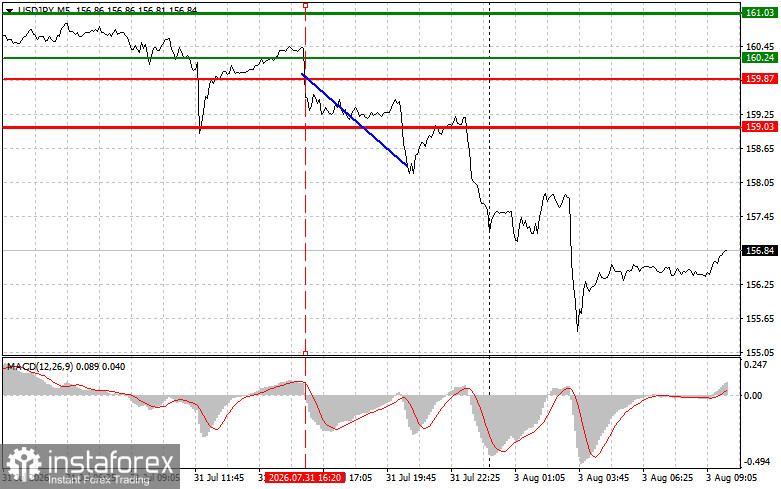
The price test at 159.87 coincided with the moment when the MACD indicator was beginning to move downward from the zero mark, confirming the correct entry point for selling the dollar. As a result, the pair fell by 100 pips.
Last Friday, the dollar failed to hold its positions against risk assets, despite a steady upward correction in the first half of the day. By midday, the situation began to change. The weakening of the dollar became more pronounced, prompting traders to reassess their positions. Both technical factors and growing concerns about new interventions drove this. The new bearish momentum in the pair was supported by large-scale currency interventions by the Bank of Japan in recent days. These measures, aimed at stabilizing the national currency's exchange rate and preventing excessive strengthening, were effective in restoring the yen's strength.
The actions of the BoJ sparked lively discussions among analysts. On the one hand, the interventions helped curb the sharp depreciation of the yen, which is important for Japan's export-dependent economy. On the other hand, such actions could destabilize other currency pairs, as seen clearly in the euro and pound against the US dollar, and provoke countermeasures from other central banks. The market will closely monitor the central bank's further reactions and the potential implications for the global financial system.
Regarding intraday strategy, I will primarily implement scenarios #1 and #2.
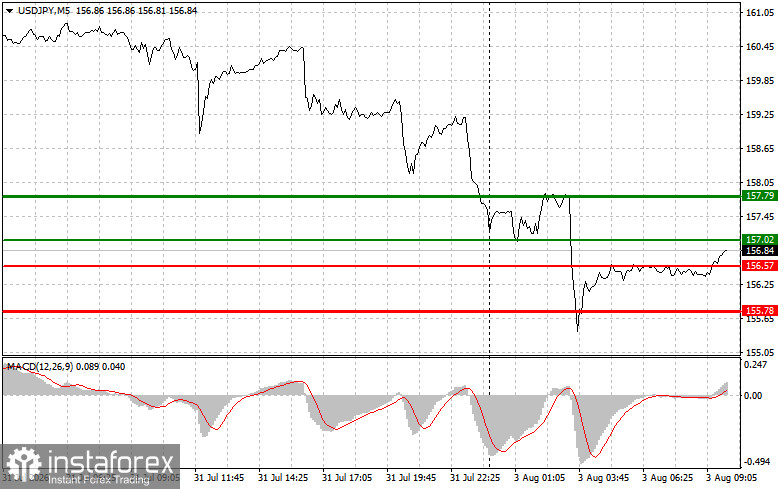
Scenario #1: I plan to buy USD/JPY today upon reaching the entry point around 157.02 (the green line on the chart) with a target growth to the level of 157.79 (the thicker green line on the chart). Around 157.79, I intend to exit the long positions and open short positions in the opposite direction (expecting a move of 30-35 pips in the opposite direction from the level). It is best to return to buying the pair during corrections and significant pullbacks of USD/JPY. Important! Before buying, ensure that the MACD indicator is above the zero mark and just beginning its ascent from it.
Scenario #2: I also plan to buy USD/JPY today if there are two consecutive tests of the price at 156.57, at the moment when the MACD indicator is in the oversold area. This will limit the pair's downward potential and lead to an upward market reversal. Growth can be expected towards the opposite levels of 157.02 and 157.79.
Scenario #1: I plan to sell USD/JPY today only after the 156.57 level is updated (the red line on the chart), which will lead to a rapid decline in the pair. The key target for sellers will be 155.78, where I plan to exit the shorts and immediately open a long position in the opposite direction (expecting a move of 20-25 pips in the opposite direction from the level). Sellers will return at any moment, needing only a hint from the central bank. Important! Before selling, ensure that the MACD indicator is below the zero mark and just beginning its descent from it.
Scenario #2: I also plan to sell USD/JPY today if there are two consecutive tests of the price at 157.02 when the MACD indicator is in the overbought area. This will limit the pair's upward potential and lead to a downward market reversal. A decline can be expected towards the opposite levels of 156.57 and 155.78.
Important: Beginner forex traders need to make entry decisions very cautiously. Before key fundamental reports are released, it is best to stay out of the market to avoid sharp price fluctuations. If you decide to trade during news releases, always set stop orders to minimize losses. Without placing stop orders, you can quickly lose your entire deposit, especially if you do not practice money management and trade large volumes.
And remember, successful trading requires a clear trading plan, as outlined above. Making spontaneous trading decisions based on the current market situation is inherently a losing strategy for intraday traders.


